How Laser Tattoo Removal Actually Works
Tattoo ink is a foreign substance your body was never able to fully clear on its own — it sits in the dermis, held in place by scar tissue and immune cells, which is why tattoos are permanent without intervention. Laser tattoo removal exploits a principle called selective photothermolysis: the enlighten® laser is tuned to wavelengths that tattoo pigment absorbs far more readily than the surrounding skin does, so energy is delivered almost exclusively to the ink itself rather than heating healthy tissue. When that concentrated energy hits an ink particle, it happens too fast for the particle to simply heat and dissipate — instead, the rapid energy delivery creates a photoacoustic effect, essentially a tiny shockwave that shatters the ink particle into much smaller fragments. That’s the “snap” sensation many patients report during treatment.
Why Pulse Duration Matters: Nanosecond vs. Picosecond
The enlighten® system is notable for offering both nanosecond and picosecond pulse durations on one platform. A nanosecond pulse delivers energy over a billionth-of-a-second window; a picosecond pulse is roughly a thousand times faster still. The shorter the pulse, the more purely photoacoustic (fragmenting) the effect and the less photothermal (heating) bleed-over into surrounding tissue — which generally means finer fragmentation with less risk of collateral thermal damage. Different ink colors and particle sizes respond better to one pulse duration or the other, so having both available lets Allie match the technology to what’s actually in your skin instead of running every tattoo through a single fixed setting.
Why Black and Red Clear More Easily Than Green and Blue
Black tattoo ink is essentially a broad-spectrum absorber — it takes in laser energy across a wide range of wavelengths, which is why black ink typically responds fastest and most predictably to treatment. Red ink also tends to clear well for similar reasons. Green and blue pigments are chemically more selective: they only absorb strongly at narrower, specific wavelengths, so achieving effective fragmentation often requires more precisely targeted settings and, in practice, more total sessions. Any provider who tells you “all ink colors respond the same” either hasn’t examined the physics or isn’t being straightforward with you about what to expect.
Where the Fragmented Ink Goes: Macrophage and Lymphatic Clearance
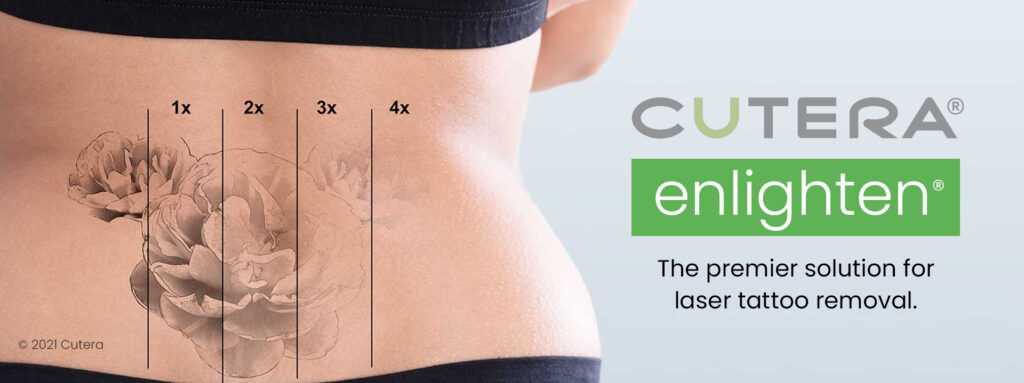
Shattering the ink particles is only step one — your body still has to remove the debris. Once pigment is fragmented into pieces small enough to be mobile, specialized immune cells called macrophages engulf the fragments, and your lymphatic system gradually transports that material away from the treatment site over the following weeks. This is precisely why tattoo removal cannot happen in a single visit and why sessions are spaced roughly 6-8 weeks apart: that interval gives your immune system time to finish clearing one round of fragmented ink before the next laser pass adds more debris for it to process. Rushing sessions closer together doesn’t speed up removal — it just asks an already-working clearance system to handle more material before it’s caught up.
The Kirby-Desai Scale: Why Session Estimates Vary So Much
Providers who give a serious answer to “how many sessions will I need” are typically drawing on a framework similar to the Kirby-Desai scale, a predictive model that scores a tattoo across multiple factors — skin type, location on the body, degree of ink layering, whether the tattoo was done by an amateur or a professional, how much scarring or tissue change is already present, and the color composition of the ink itself. Each factor shifts the estimate up or down, which is why two tattoos of similar visual size can require very different numbers of sessions. Allie evaluates these same factors during consultation before quoting a session estimate — a substantive assessment, not a generic range pulled from a brochure.
Who Is a Good Candidate?
Most healthy adults seeking to remove or fade unwanted ink are reasonable candidates for an evaluation, but certain conditions require a delay or disqualify treatment until they’re resolved:
- Recent sun exposure or a tan on the treatment area — treating tanned skin increases the risk of pigment complications and burns
- Current or recent use of isotretinoin (Accutane) — this medication affects skin healing and is a standard contraindication for laser procedures
- A personal history of keloid scarring — this raises the risk of abnormal scar formation at the treatment site
- Active infection, rash, or open skin at the treatment site
- Pregnancy — as with most elective laser and injectable procedures, treatment is deferred
- Use of photosensitizing medications that increase skin sensitivity to light-based treatments
Allie reviews your health history and the specific tattoo at consultation to confirm whether you’re a good candidate and whether any of these factors need to be addressed first.
What to Expect From Tattoo Removal
How completely a tattoo clears depends largely on the ink. Some ink formulations — particularly certain cosmetic tattoo pigments used in permanent makeup — contain compounds that can undergo paradoxical darkening when hit with laser energy, meaning the color temporarily or in rare cases permanently deepens rather than fading. Older tattoos with heavily layered or amateur-applied ink may also plateau at partial fading rather than full clearance. Allie evaluates your specific ink at consultation and builds your session plan around how it’s likely to respond.
Why Physician Oversight Changes the Risk Calculus
Laser tattoo removal is a medical procedure with real potential for burns, blistering, infection, and permanent pigment change when energy settings don’t match the patient’s skin type and ink composition. Alexandra “Allie” Wade, our Cutera-certified Medical Esthetician with over nine years of experience, selects the settings and administers every treatment herself, working inside a physician-owned medical spa under the medical direction of Dr. John M. Purcell Jr., MD. That combination — a specialist who performs the procedure daily, backed by physician oversight for any case that needs it — is the safeguard, not a marketing point.
What the Research Says
The mechanism behind laser tattoo removal — selective photothermolysis and the photoacoustic fragmentation of ink particles — is described in the National Library of Medicine’s StatPearls reference entry on laser tattoo removal (ncbi.nlm.nih.gov/books/NBK442007), and a systematic review of Nd:YAG-based tattoo removal is indexed on the National Library of Medicine’s PubMed Central archive (pmc.ncbi.nlm.nih.gov/articles/PMC13276302). The FDA also publishes a consumer-facing fact sheet on tattoos and permanent makeup (fda.gov/cosmetics/cosmetic-products/tattoos-permanent-makeup-fact-sheet) covering general considerations around tattoo pigment and its removal. Individual results vary by ink composition, skin type, and technique, which is exactly why Allie evaluates every tattoo in person before estimating a session count rather than quoting a number sight-unseen.