What a VISIA Skin Analysis Actually Measures
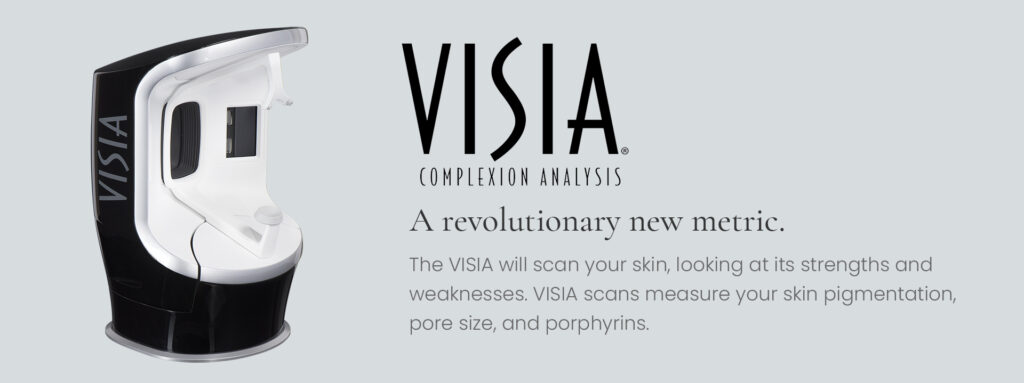
The Canfield VISIA® Complexion Analysis System reports on eight standard skin features: spots, wrinkles, texture, pores, UV spots, brown spots, red areas, and porphyrins. Each one is a real, quantified measurement rather than a subjective impression — instead of “you have some sun damage,” you get a specific reading for UV spots compared against a percentile score for people your same age and skin type. That percentile comparison is what turns a photograph into useful clinical information: it tells you not just what’s present, but whether it’s typical or elevated for someone in your demographic.
The Imaging Technology Behind the Scan
VISIA captures three distinct types of images in one sitting: standard photography, cross-polarized light, and UV light. Cross-polarized imaging filters out surface glare and reveals subsurface skin conditions that standard photography and the naked eye both miss — texture irregularities, deeper pigmentation, and vascular patterns beneath the surface. UV photography works differently: it’s used specifically for sun-damage assessment and can reveal porphyrins, byproducts associated with acne-related bacteria, through UV fluorescence that isn’t visible under normal light. Layered on top of both is Canfield’s RBX® technology, which separates the unique red and brown color signatures in your skin — a distinction that helps visualize conditions like rosacea, hyperpigmentation, and acne-related redness far more precisely than a standard photo can.
How Your Results Compare — Percentile Scoring and TruSkin Age
Raw measurements only mean so much on their own, which is why VISIA compares each of your eight results to a percentile score drawn from others of your same age group and skin type. Your results can also generate a TruSkin Age® estimate, Canfield’s metric for how your skin’s apparent condition compares to a peer database. It’s context. A percentile score and an age estimate are planning tools that help Dr. Purcell recommend the right starting point, whether that’s a lighter facial, a targeted peel, or a laser treatment, rather than defaulting to whatever’s on this month’s promotion.
What Happens During Your Appointment
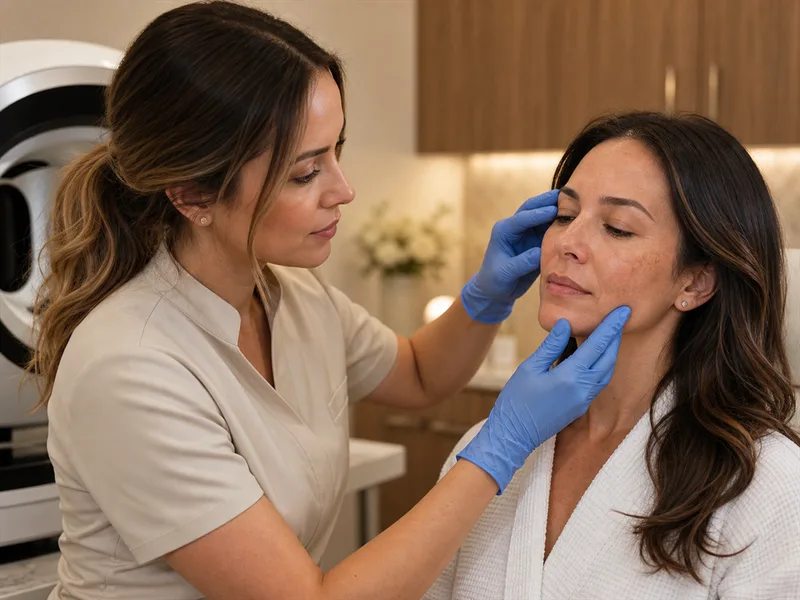
Most VISIA appointments run about 30 minutes. The imaging itself — the standard, cross-polarized, and UV captures — takes only a few minutes; the rest of your visit is spent going through the results with Dr. Purcell, one measurement at a time, in plain language. Nothing touches your skin during the capture — no numbing and no needles are involved — and you walk out and go straight back to your day. You can come straight from work if you need to, though a clean face without makeup gives the sharpest cross-polarized and UV images.
Who Is a Good Candidate for a VISIA Skin Analysis?
Almost anyone curious about the actual condition of their skin is a reasonable candidate — you rest your chin on a padded rest while the system takes three photographs in a few seconds, nothing touches your skin, and no numbing or needles are involved. A few things are worth knowing before you book:
- If you have a mole, lesion, or spot that concerns you, point it out at your visit and Dr. Purcell can evaluate it directly
- There’s no medical prerequisite to qualify for a scan — it’s appropriate for a first-time patient exploring options just as much as for someone tracking results from an existing treatment plan
- Because the scan is repeatable, it’s genuinely useful both before you’ve started any treatment and later on, as a way to check whether a treatment plan is actually working
Because a physician reviews every scan here, if anything looks like it deserves closer medical attention, Dr. Purcell will tell you directly and guide your next step.
From Scan to Skincare Plan — What Dr. Purcell Does With Your Results
A VISIA scan on its own is just data. What makes it useful is what happens next: Dr. John M. Purcell Jr., MD, brings 20+ years of experience as a physician (MD) to that interpretation. Separately, he has clinical dermatology research experience from the University of Houston. Together, that background is what connects your eight measurements to Capital Skin’s actual treatment menu. Elevated pigmentation or UV spots typically point toward PICO Genesis or Excel V. Texture and fine-line findings above your percentile group usually lead toward RF Microneedling or SmartSkin+ CO2 Restoration. Red-area findings point toward Laser Genesis, and pore or porphyrin readings usually route toward a facial or, where scarring is involved, dedicated acne scar treatment. None of that is decided for you on the spot — it’s a starting point for a conversation, not a sales script.
What the Research Says
General FDA consumer guidance on cosmetic and skin-imaging-adjacent products is available at the FDA’s cosmetics resource (fda.gov/cosmetics). Background on skin exfoliation and resurfacing treatments that a VISIA finding often leads toward is covered in the National Library of Medicine’s StatPearls reference entry on chemical peeling (ncbi.nlm.nih.gov/books/NBK547752). As with any skin assessment, individual results depend on skin type, tone, and history — which is exactly why every VISIA scan at Capital Skin is reviewed by a physician rather than handed back as a printout with no context.